Lawn mowing price calculator
Price the visit, including drive time, then the season.
Example
Biggest lever: Minutes on site. +10% raises the result to $75.29.
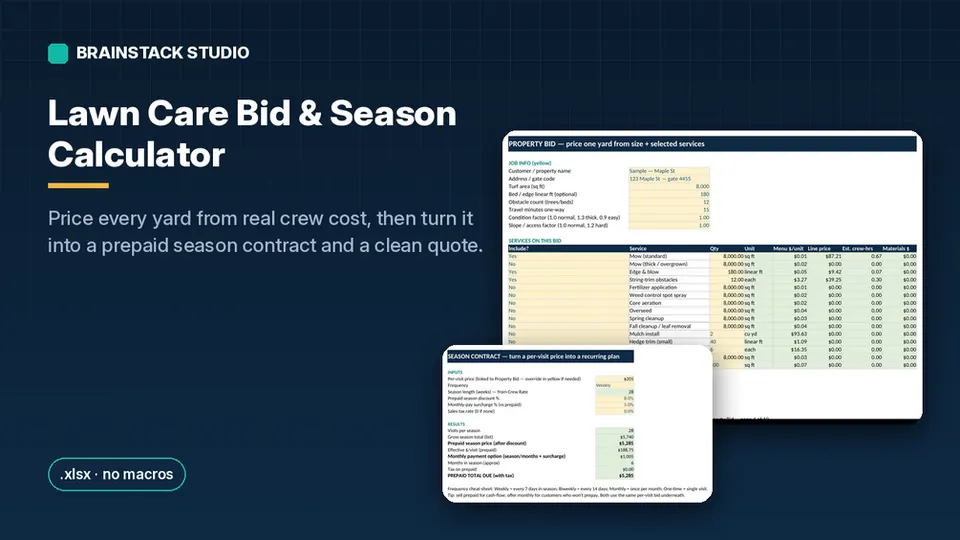
Take this further in the full workbook
Example: $69.86. Crew bids and prepaid season plans.
Excel workbook (.xlsx)
Details
How it works
- Crew hours = (on-site + drive minutes) ÷ 60 × crew size
- Direct cost = crew hours × wage × (1 + burden) + equipment hours × equipment rate
- Price per visit = direct cost ÷ (1 − overhead % − profit %)
- Season = price per visit × visits; monthly = season ÷ billing months
Example
With minutes on site 35, drive minutes 10, crew size 2, wage per crew member 18 $/hr, labor burden 20%, truck & equipment cost per hour $22, overhead 15%, profit 15%, visits per season 28, billing months 8, prepay discount 5%: price per visit $69.86; season total $1,956.00; monthly installment $244.50.
Questions
Is this a recommended price for my area?
No. It calculates a price from your own time, costs, and percentage assumptions. It does not survey local competitors or assess customer demand. The default figures are examples, not a regional price guide.
Does crew size multiply equipment costs?
No. It multiplies labor-hours only. Equipment cost uses elapsed site-plus-drive time and the hourly equipment allowance. Adjust that allowance yourself if the crew arrangement changes the equipment actually needed.
Does the monthly amount change when a month has more visits?
Not within this model. Monthly billing is the season total divided by billing months. It is an even allocation, not a month-by-month service calendar. Your actual agreement should explain the payment schedule.
Does a prepayment discount lower my operating cost?
The calculator applies it to revenue only. Costs are unchanged in the model. Evaluate the discount against real costs and collection considerations rather than assuming the percentage comes out of an equally large cost saving.
Can I include extra seasonal services?
There are no separate line items for them. Estimate materially different services separately or use a fuller worksheet. Do not assume that multiplying identical mowing visits includes every seasonal task a customer may expect.
Understand the calculation
Price the stop as part of a route
This calculator models the cost and price of a lawn-service visit, then extends it into a season and a monthly billing amount. It starts with minutes on site, the drive time assigned to that stop, crew size, wage, labor burden, and an equipment cost per hour. It does not measure a property, estimate mowing speed from acreage, or retrieve local competitor prices. The inputs need to describe the actual service you intend to provide.
Define whether the visit includes mowing alone or also edging, trimming, blowing, clipping handling, or other tasks. Record exclusions separately. The calculator has no separate task list, so the on-site minutes must represent the complete included visit. A short mowing time does not automatically cover setup, loading, cleanup, gates, or obstacles. Your estimate must account for the work behind the customer-facing description.
Keep crew time and equipment time distinct
The engine adds on-site and drive minutes, converts them to hours, and multiplies by crew size to obtain labor-hours. Labor cost is those hours times wage times one plus the burden percentage. Equipment cost uses the elapsed visit-plus-drive hours without multiplying by crew size. This is a deliberate model difference: two workers do not automatically mean two trucks or two identical equipment cost packages.
Enter an equipment hourly allowance that matches the truck and equipment arrangement being priced. If a larger crew requires additional equipment, revise the allowance rather than expecting the crew-size field to do it for you. Likewise, drive minutes should be the share assigned to this visit, not an entire route’s travel charged to every stop. The calculator does not allocate travel automatically or optimize the route.
Walk through a hypothetical visit
For an illustrative visit, assume 35 minutes on site, 10 allocated drive minutes, two workers, an $18 wage, a 20% labor burden, and $22 per elapsed hour for truck and equipment. The visit occupies 0.75 elapsed hours and 1.5 labor-hours. Modeled labor cost is $32.40 and equipment cost is $16.50, giving $48.90 in included direct cost.
With overhead and profit each entered as 15% of price, the engine divides $48.90 by 0.70. The result is approximately $69.86 per visit. For 28 identical visits, the modeled season price is $1,956.00. Dividing that season price over eight billing months produces $244.50 per month. These figures demonstrate the formula, not what a particular lawn should cost or how quickly a crew should work.
Treat the season schedule as an assumption
The season calculation multiplies the unrounded visit price by the number of visits. It assumes each visit has the same modeled costs and scope. Actual work can vary, so review the assumptions when service frequency, growth conditions, access, or the included task list changes. The calculator does not know whether a visit is skipped, rescheduled, shortened, or supplemented with extra work.
The monthly output spreads the season total across the entered billing months. It is not a count of visits performed in that particular month, and it does not establish the terms of a billing agreement. Decide how your actual offer addresses changes in service dates and scope through the normal quoting process. Keep the total season obligation and the payment schedule understandable to the customer.
Understand the cost of a prepayment discount
The prepaid output reduces the season selling price by the entered discount percentage. It does not reduce labor, equipment, or overhead costs. In the example, a 5% discount changes the $1,956.00 season total to $1,858.20, a $97.80 revenue reduction. That amount must be weighed against your actual business reasons for offering the discount rather than treated as costless.
The reference table changes only allocated drive time from the base example. It shows why route assumptions can matter even when the lawn itself is unchanged. The table holds service time, equipment allowance, crew, wage, and percentages constant. It is not evidence that every route can reach the shortest travel time or that customers should be charged solely according to distance.
Use actual jobs to improve the next estimate
Compare planned and actual labor-hours, drive allocation, equipment expense, and visits completed. Keep the original inputs so that the comparison explains a variance rather than erasing it. If visits routinely take longer, determine whether the issue is scope, scheduling, estimating, or something else before changing the price. A lower recorded time is not useful if the promised work was not completed.
The calculator does not include separate material, disposal, tax, or repair fields. Include relevant expenses in a defensible cost plan and do not present the displayed profit allowance as verified net income. It also does not sell a contract or collect a payment. Use the result as one input to a complete offer, supported by your own operating records and appropriate business review.
Reference examples
| Allocated drive minutes | Labor cost | Equipment cost | Price per visit |
|---|---|---|---|
| 0 | $25.20 | $12.83 | $54.33 |
| 5 | $28.80 | $14.67 | $62.10 |
| 10 | $32.40 | $16.50 | $69.86 |
| 20 | $39.60 | $20.17 | $85.38 |
Sources and method notes
Reviewed 2026-11-16. Worked examples are hypothetical and calculated from the formulas shown, not market benchmarks.
- SBA: break-even point calculator
Background on cost and selling-price assumptions. All service examples here are hypothetical calculations, not market-rate data.
Related calculators
Estimates only. Check them before you bid. Nothing you type is saved. Method & disclosures