Retainage & pay application calculator
Payment-application arithmetic only. Verify contract terms, applicable rules and cumulative records; this calculator does not certify work or establish payment entitlement.
Example
Biggest lever: Work completed to date. +10% raises the result to $50,800.00.
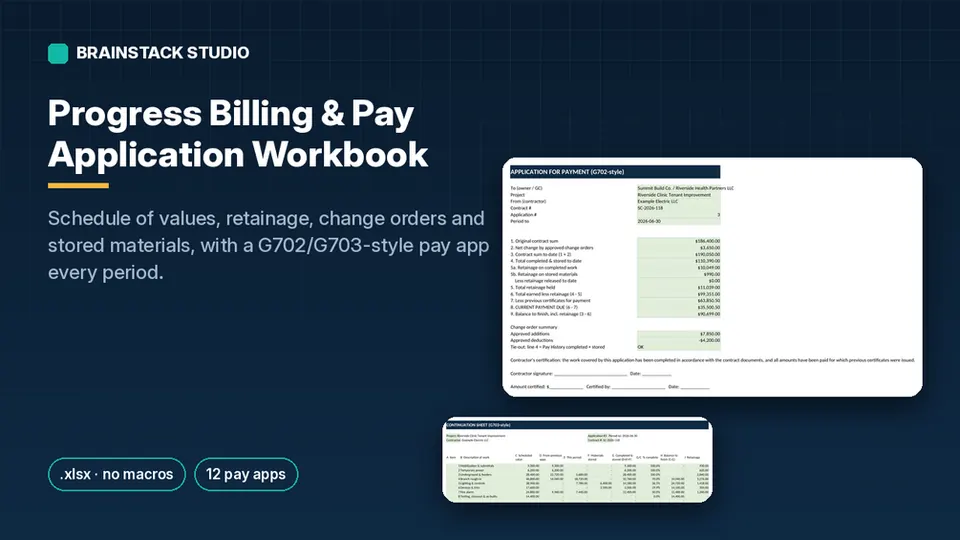
Take this further in the full workbook
Example: $38,200.00. Pay apps that carry retainage forward.
Excel workbook (.xlsx)
Details
How it works
- Retainage = completed work × work % + stored materials × stored %
- Earned less retainage = completed + stored − retainage
- Current payment due = earned less retainage − previous certificates
- Balance to finish = contract sum to date − earned less retainage
Example
With original contract sum $250,000, net change orders $12,000, work completed to date $140,000, materials presently stored $8,000, retainage on completed work 10%, retainage on stored materials 10%, previous certificates for payment $95,000: current payment due $38,200.00; total retainage held $14,800.00; total earned less retainage $133,200.00.
Questions
What retainage percentage should I enter?
Use the percentage applicable to your actual agreement and situation after appropriate review. The calculator does not determine statutory limits, contractual entitlement, release conditions, or whether different work items require different treatment.
Should completed work mean this period only?
No. The engine expects cumulative completed work and stored-material values, then subtracts previous certificates. Mixing this-period and cumulative inputs can materially misstate the current amount.
Why does balance to finish include retainage?
The engine subtracts earned-less-retainage from adjusted contract value. That leaves both unearned contract value and the modeled retained amount in the balance. It is not simply the remaining physical work value.
Does current due mean the owner has approved payment?
No. It is a calculated amount based on your inputs. It does not establish approval, certification, invoice delivery, legal entitlement, or cash receipt. Those events require their own records.
Can this generate an official AIA payment application?
No. It is an independent calculator. It does not reproduce, license, execute, or submit an AIA document and is not a substitute for the forms and procedures required on your project.
Understand the calculation
A reconciliation aid, not a payment certification
This calculator illustrates how cumulative completed work, stored materials, retainage percentages, and previous certificates affect a modeled current payment amount. It does not determine the retainage allowed by law or by your contract, certify that work is acceptable, or establish a legal right to payment. Use the applicable agreement and your actual payment-application records to choose the inputs.
AIA’s description of its payment-application documents identifies contract value, completed and stored work, retainage, prior amounts, and changes as information used in that process. This calculator is an independent arithmetic tool, not an AIA form, licensed document, or substitute for the project’s required application and certification workflow. Its output does not sign or submit anything.
Use cumulative figures on a consistent cutoff date
The work-completed and stored-materials inputs are cumulative amounts for the calculation date, not just this month’s new work. The engine applies separate retainage percentages to those two inputs and adds the results. It then subtracts retainage from their combined total. Finally, it subtracts previous certificates to calculate the modeled amount currently due.
Keep the cutoff date and scope consistent across the inputs. Reconcile completed-work totals with the supporting project records, stored materials with the appropriate documentation, and previous certificates with the approved history. The calculator cannot distinguish a current-period amount from a cumulative amount. Entering one where the other is intended can produce a plausible-looking but materially wrong result.
Work through a cumulative example
Assume a hypothetical original contract of $100,000, $5,000 of changes included in the calculation, $50,000 of cumulative completed work, and $10,000 of stored materials. For illustration, enter 10% retainage on completed work and 5% on stored materials. Retainage is $5,000 plus $500, or $5,500. The combined $60,000 less retainage is $54,500.
If previous certificates total $40,000, the modeled current amount is $14,500. The adjusted contract value is $105,000, and the calculator’s balance-to-finish output is $50,500. That balance includes the retained amount because the engine subtracts earned-less-retainage, not simply the completed-and-stored total. None of these example percentages is a recommendation or a statement of what applies to a particular project.
Separate certificates, invoices, and collected cash
The previous-certificates field is not automatically the amount deposited in your bank account. Certification, billing, and cash collection can have different histories. Use the figure appropriate to the payment-application calculation being reconciled rather than substituting bank receipts without review. Otherwise a delayed payment could be counted as though it were new work to bill again.
The calculator does not import a receivables ledger, identify unpaid certificates, or reconcile deposits. If you also need to understand cash still outstanding, perform that reconciliation separately against the relevant invoices and receipts. A current payment calculation can be correct while a prior payment remains uncollected. Keeping these observations separate prevents an arithmetic aid from becoming an unreliable cash report.
Review changes and stored materials deliberately
The change-orders input changes the contract-value denominator and balance calculation. The engine does not review the status, documentation, or authorization of those changes. Include only the value appropriate to the actual application and governing process. A proposed change is not automatically the same as a change accepted for billing, and the calculator cannot make that decision.
Stored materials are entered as one amount with one retainage percentage. This model does not track each item, location, ownership, insurance, transfer to installed work, or the supporting evidence required by the project. When material becomes installed, reconcile the cumulative records so the same value is not counted both as stored and as completed work. Use the contract and responsible reviewer to determine what is eligible.
Read the sensitivity table without changing the contract
The reference table holds the example’s completed work, stored materials, and previous certificates constant while changing the completed-work retainage input. It demonstrates the numerical effect only. A lower rate increases the modeled current amount, but entering it does not authorize a release or amend a contract. Follow the actual review and approval process before applying a changed rate.
This simple engine applies the entered percentages to the entire cumulative amounts. It does not maintain historical rate tiers, line-item-specific retainage, milestone releases, or special exceptions. If the project uses those features, reconcile them in a detailed schedule rather than forcing them into one averaged percentage and assuming the result is exact.
Check the result before it leaves your desk
Review the arithmetic against the supporting schedule and the previous accepted application. Confirm that the contract value, changes, cumulative work, stored materials, and prior certificates refer to the same project and date. Preserve a copy of the inputs and the documents used to establish them. A reviewer should be able to reproduce the amount without guessing which version of the job record was used.
The displayed completion percentage is completed-plus-stored value divided by adjusted contract value. It is not a physical inspection or proof that the project is that far finished. Likewise, a negative current amount is a reconciliation signal, not an automatic refund instruction. Resolve unusual results with the project’s accounting and contract process; obtain qualified advice when legal rights or reporting treatment are in question.
Reference examples
| Work retainage rate | Total retainage | Earned less retainage | Modeled current amount |
|---|---|---|---|
| 0% | $500 | $59,500 | $19,500 |
| 5% | $3,000 | $57,000 | $17,000 |
| 10% | $5,500 | $54,500 | $14,500 |
| 15% | $8,000 | $52,000 | $12,000 |
Sources and method notes
Reviewed 2026-11-16. Worked examples are hypothetical and calculated from the formulas shown, not market benchmarks.
- AIA Contract Documents: G702 summary
Background on payment-application information and certification. This independent calculator is not an AIA form or certification.
Related calculators
Estimates only. Check them before you bid. Nothing you type is saved. Method & disclosures