WIP over/under billing calculator
Simplified cost-to-cost illustration, not a revenue-recognition determination or journal entry. Verify the appropriate accounting method, contract value and current cost forecast.
Example
Biggest lever: Billed to date. +10% raises the result to $53,000.00.
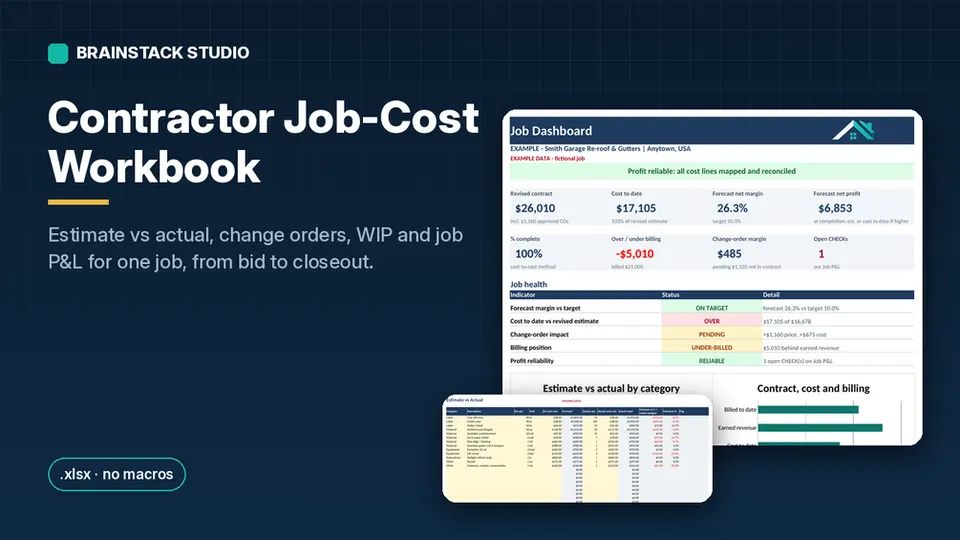
Take this further in the full workbook
Example: $30,000.00. Estimate versus actual on every job.
Excel workbook (.xlsx)
Details
How it works
- Percent complete = cost to date ÷ estimated total cost
- Earned revenue = contract × percent complete
- Over/under billing = billed to date − earned revenue
Example
With contract price $400,000, estimated total cost $320,000, cost to date $160,000, billed to date $230,000: over (+) / under (−) billing $30,000.00; percent complete 50.0%; earned revenue $200,000.00.
Questions
Does overbilled mean the customer paid too much?
Not necessarily. Here it means the billed input exceeds the simple modeled earned-revenue amount. The calculator does not evaluate payment entitlement, actual collections, or whether the accounting method is appropriate.
Should I enter cash received in billed to date?
No. This model compares billing with calculated earnings. Cash receipts answer a separate question. Reconcile invoices and collections independently so that timing differences are not mistaken for the same event.
Can I use the original estimate for total cost?
Only if it remains the appropriate forecast for your analysis. The engine cannot update it. Review incurred and remaining costs through your project process rather than assuming the original bid is still accurate.
Does the asset or liability label create an accounting entry?
No. The label is a simplified model classification. It does not determine presentation under an accounting standard, create a journal entry, or replace review by the responsible accountant.
Why can percentage complete exceed 100%?
The engine divides costs to date by estimated total cost without a cap. A result above 100% means those inputs exceed the estimate relationship. Review the forecast and method; it is not certification that additional physical work has been completed.
Understand the calculation
Understand the narrow purpose of this WIP calculator
This work-in-progress calculator compares billed-to-date amounts with a simple cost-to-cost estimate of earned revenue. It takes four inputs: contract value, estimated total cost, cost incurred to date, and billed amount to date. It is useful for exploring the arithmetic and reviewing whether the inputs tell a coherent story. It is not a complete construction accounting system or a determination of the revenue recognition method appropriate to your contract.
The result does not establish compliance with US GAAP, IFRS, tax rules, or lender reporting requirements. Accounting standards require judgments that four numbers cannot resolve. For example, an IFRS Foundation staff paper discussing IFRS 15 describes input methods and questions about choosing a measure of progress. This calculator simply applies one cost ratio; it does not perform the underlying standards assessment.
Trace the cost-to-cost calculation
The engine divides cost to date by estimated total cost to obtain its percentage-complete figure. It multiplies contract value by that ratio to calculate modeled earned revenue. Billed to date minus earned revenue then produces the over-or-under amount. A positive result is labeled overbilled and a negative result underbilled. These are labels for the simplified comparison, not automatic ledger entries.
Consider a hypothetical $100,000 contract with $80,000 of estimated total cost and $40,000 of costs recorded to date. The modeled completion ratio is 50%, and earned revenue is $50,000. If billing to date is $55,000, the difference is $5,000 overbilled in this model. Projected gross profit is $20,000, while modeled gross profit to date is $10,000. None of those figures proves that cash has been received.
Make estimated total cost a current forecast
The total-cost input should describe the estimate at completion being used for the analysis, not merely an old bid number left unchanged as the project evolves. Reconcile costs already recorded with the remaining work and expected costs through the appropriate project review. The calculator does not build that forecast, identify committed purchases, or know whether the remaining estimate is complete.
If estimated total cost increases while cost to date stays unchanged, the calculated percentage complete falls. In the example, changing the estimate from $80,000 to $90,000 reduces the ratio to about 44.44% and modeled earned revenue to about $44,444.44. That is the formula’s response to the new assumption. It does not by itself determine how an accounting adjustment should be recorded or approved.
Keep billing and cash separate
Billed to date is not the same input as cash collected to date. An invoice can be issued without being paid, and a payment can relate to a different period from the current cost report. Entering bank receipts in the billing field changes the question being answered. Maintain a separate receivables and cash reconciliation rather than trying to infer liquidity from the over-or-under label.
Likewise, overbilling does not automatically mean a project has excess cash available to spend. The model does not track payment timing, future commitments, retainage, disputes, or unrestricted cash. Underbilling does not automatically prove a collection problem or an error. Review the underlying billing terms, project records, and accounting treatment before deciding what action the difference warrants.
Reconcile the data cutoff and contract value
Use cost and billing records with a consistent cutoff date. A cost report through one month and invoices through a later month can create a difference caused by timing rather than the job’s underlying position. Identify pending entries, corrections, and the source of each input in the review record. This calculator has no ledger connection and cannot detect a missing invoice or unposted cost.
The contract-value field is a single amount. The engine does not distinguish original scope, changes, claims, variable consideration, or separate performance obligations. Use the amount appropriate to the analysis after the necessary accounting review. Do not assume that entering a proposed change makes it earned revenue or an enforceable receivable. Keep supporting decisions outside the calculator with the records that justify them.
Use the table to test assumptions, not certify progress
The reference table holds contract value at $100,000, costs to date at $40,000, and billing at $55,000, while varying estimated total cost. It shows how strongly the result depends on the remaining-cost forecast. It is not a physical progress inspection, a production schedule, or a promise about project profitability. Cost incurred and actual work transferred to a customer do not always move in perfect proportion.
The engine does not adjust for unusual cost patterns, uninstalled materials, inefficiencies, or contract-specific accounting requirements. It also does not cap the cost ratio at 100%. If costs to date exceed estimated total cost, investigate the forecast and reporting method rather than treating an above-100% result as validated progress. A zero total-cost estimate leaves the ratio undefined and cannot support a meaningful output.
Review the outcome with an accountable owner
Keep a dated version of the inputs and the reason for each material forecast change. Compare the result with the job’s cost review, billing history, and the financial reports prepared through your established accounting process. Escalate discrepancies to the person responsible for that reporting rather than posting the calculator result directly to a ledger.
The projected margin output uses contract value minus estimated total cost, divided by contract value. It is a project-level calculation based on the costs entered, not a measure of company net income or collected revenue. Company overhead and other expenses may still be outside that boundary. Treat the tool as a transparent check that supports professional judgment, not as a replacement for it.
Reference examples
| Estimated total cost | Modeled completion | Modeled earned revenue | Billing above modeled earnings |
|---|---|---|---|
| $70,000 | 57.14% | $57,142.86 | -$2,142.86 |
| $80,000 | 50.00% | $50,000.00 | $5,000.00 |
| $90,000 | 44.44% | $44,444.44 | $10,555.56 |
| $100,000 | 40.00% | $40,000.00 | $15,000.00 |
Sources and method notes
Reviewed 2026-11-16. Worked examples are hypothetical and calculated from the formulas shown, not market benchmarks.
- IFRS Foundation: staff paper on timing of revenue recognition (March 2024)
Primary background on the judgment involved in measures of progress. This staff paper is not an endorsement of the calculator or a US GAAP compliance claim.
Related calculators
Estimates only. Check them before you bid. Nothing you type is saved. Method & disclosures